Could AI Use More Energy Than It Saves in the UK?
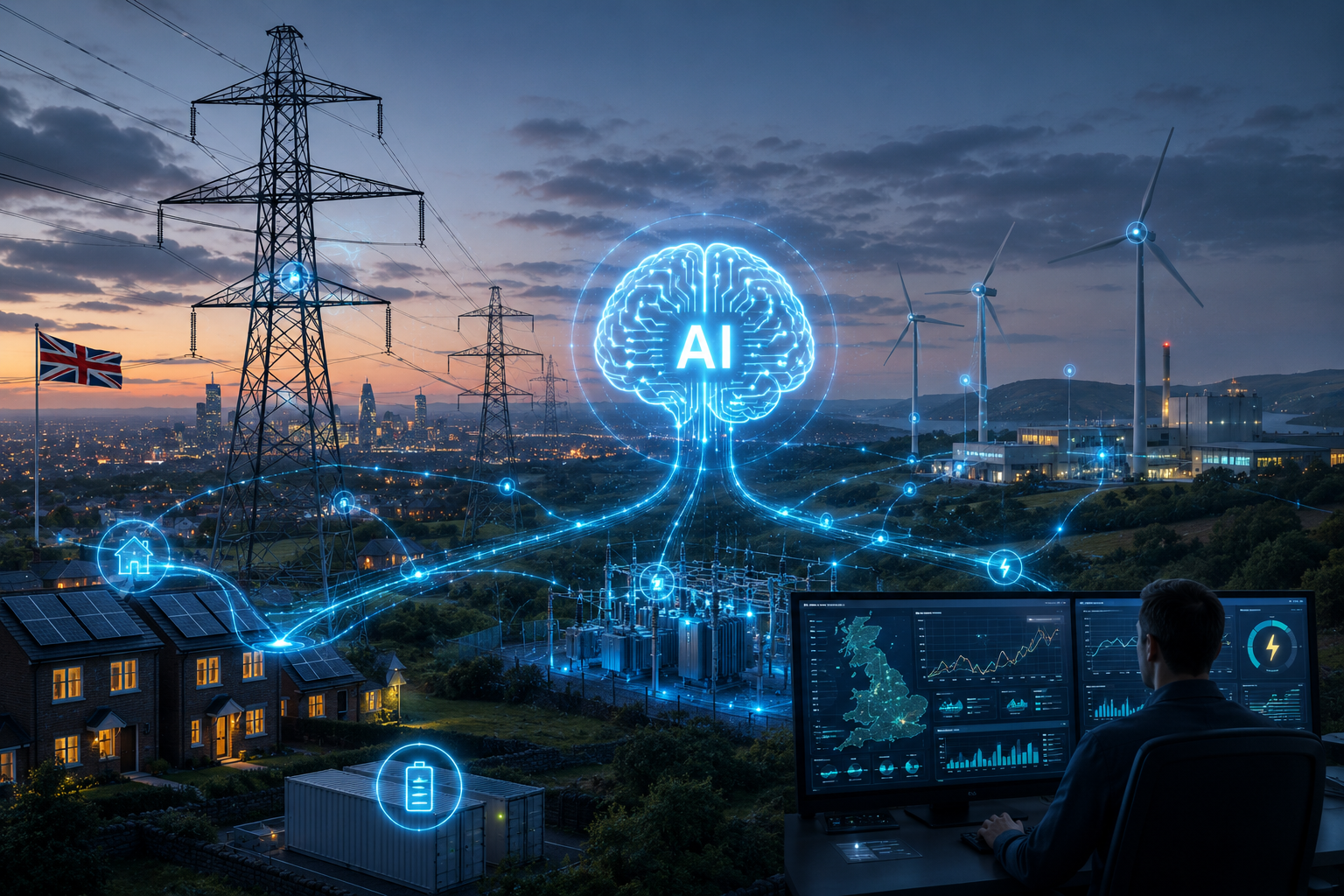
AI can reduce wasted energy in buildings, factories, transport and the electricity grid. However, rapidly expanding data-centre demand could consume those savings. The answer depends on how Britain chooses to use and power AI.
This article predates our current evidence standard and has not yet completed source review. Figures should be treated with caution until it has. Editorial standards
The short answer is yes, it could.
Artificial intelligence can identify wasted electricity, improve renewable-energy forecasting, optimise industrial equipment and reduce fuel consumption. At the same time, developing and operating AI requires energy-intensive computer processors housed inside data centres that must be powered and cooled continuously.
Whether AI produces a net saving therefore depends on a deceptively simple calculation:
Energy avoided through useful AI applications minus the additional energy consumed by AI infrastructure.
Britain does not yet have sufficiently complete public data to calculate that balance accurately. Technology companies rarely disclose the full electricity consumption of individual models, while claimed savings often depend on estimates rather than independently measured results.
It would consequently be misleading to declare that AI is already producing a net energy saving across the UK. It would be equally misleading to assume that every unit of electricity consumed by AI is wasted.
The real answer is that AI can save substantially more energy than it consumes when it is applied to genuine efficiency problems. It can also become a large additional source of demand when it is deployed indiscriminately, duplicated across businesses or used for tasks that provide little measurable benefit.
Why AI Requires So Much Electricity
Training large AI models
Training a large AI model involves processing enormous datasets using thousands of specialist graphics processing units, or GPUs. These processors perform calculations in parallel and can operate continuously for weeks or months.
Electricity is required for more than the processors themselves. A data centre must also power:
Cooling and ventilation systems
Data storage
Networking equipment
Backup power systems
Lighting and security
Power-conversion equipment
Water pumps where evaporative or liquid cooling is used
The energy used to train a model is significant, but training is only part of the total footprint. Once a popular model has been released, millions of people and businesses may interact with it every day.
Inference can eventually exceed training
Every time somebody asks a chatbot a question, creates an AI image, summarises a document or runs an automated AI agent, the model performs another set of calculations. This operational stage is known as inference.
A single request may use relatively little electricity. The problem is scale.
A service handling hundreds of millions of requests can consume a substantial amount of electricity even if the energy required for each request falls. More complex activities—such as generating video, conducting multi-stage research or operating autonomous agents—can require considerably more computing than a short text response.
The AI Electricity Cost Calculator can help estimate the electricity consumption and financial cost of running different AI workloads.
AI does not replace all existing digital activity
Some AI services replace work that would otherwise have required electricity. An AI-assisted search might replace several conventional searches, for example. An automated building-control system might replace a less efficient timer-based system.
Other AI use is entirely additional.
People generate images they would not previously have produced, create multiple versions of documents, automate new monitoring processes and run AI assistants continuously. Businesses may also retain their existing software while adding AI services on top.
In those circumstances, AI is not replacing an existing energy demand. It is creating another one.
Britain’s Data-Centre Demand Is Growing
The International Energy Agency estimated that data centres worldwide consumed approximately 415 terawatt-hours of electricity in 2024, representing around 1.5% of global electricity consumption. Its 2025 Energy and AI analysis projected that this could rise to approximately 945 terawatt-hours by 2030, with AI the most important driver of growth.
The IEA subsequently reported that global data-centre electricity use increased by approximately 17% during 2025, much faster than overall global electricity demand.
UK-specific numbers are less certain because there is no complete public register recording the real-time electricity consumption of every British data centre.
Analysis drawing on National Energy System Operator figures estimates that UK data centres consumed approximately 5 terawatt-hours in 2023. That was equivalent to roughly 2% of UK electricity demand at the time.
Demand could grow rapidly as new cloud and AI facilities are connected. The Government’s 2025 Compute Roadmap said the UK would need at least 6 gigawatts of AI-capable data-centre capacity by 2030.
Capacity is not the same as annual consumption. A 100-megawatt facility will not necessarily draw its maximum rated power during every hour of the year. Nevertheless, the size of proposed connections demonstrates how AI infrastructure is becoming a material electricity-planning issue.
The Data Centre Demand Calculator demonstrates how server capacity, utilisation and cooling efficiency can change the electricity requirement of a proposed facility.
To understand where this additional demand could place pressure on substations, connection queues and regional electricity networks, read AI Data Centres and the UK Electricity Grid 2026.
Where AI Could Save Energy
Managing the electricity grid
Britain’s electricity system is becoming more complicated.
Large fossil-fuel power stations are being replaced by a mixture of offshore wind, solar farms, battery storage, interconnectors, electric vehicles and smaller distributed energy resources. Electricity can now flow in different directions, while renewable output changes with the weather.
AI can analyse weather forecasts, historic demand, generator availability and network conditions more quickly than traditional manual processes. Possible applications include:
Forecasting wind and solar generation
Predicting electricity demand
Identifying faults before equipment fails
Managing batteries and flexible loads
Detecting unusual network behaviour
Optimising maintenance schedules
Reducing renewable-energy curtailment
Helping consumers shift demand away from peak periods
The IEA has estimated that existing AI applications could unlock up to 175 gigawatts of additional transmission capacity globally by making better use of existing power lines.
This does not mean AI physically creates new cables. It means better monitoring and forecasting could allow operators to use some existing infrastructure more effectively and safely.
AI Can ‘Do More With Less’ for UK Grid Amidst Renewables Surge examines how forecasting, network monitoring and real-time optimisation could help electricity infrastructure operate more efficiently.
Reducing commercial-building consumption
Commercial buildings frequently waste electricity because heating, lighting and ventilation systems follow fixed schedules instead of responding to actual occupancy.
AI-enabled building-management systems can combine information from:
Occupancy sensors
Weather forecasts
Smart meters
Room temperatures
Electricity tariffs
Heating and cooling equipment
On-site solar panels
Battery storage
A well-designed system can heat or cool occupied areas while reducing unnecessary consumption elsewhere. It may also identify abnormal equipment behaviour before a fault causes a prolonged period of waste.
The saving is only genuine if it is measured against a credible baseline. A percentage generated by a software dashboard is not automatically proof that the building consumed less energy.
Businesses can use the AI Energy Savings Calculator to explore whether proposed efficiency improvements are likely to outweigh the electricity consumed by the AI system.

Improving supermarket refrigeration
Refrigeration can account for a very large proportion of a supermarket’s electricity consumption. Chilled cabinets, freezers, cold rooms and distribution facilities operate throughout the day and night.
AI can monitor compressor performance, cabinet temperature, door openings, weather conditions and refrigerant pressure. It can detect problems that might otherwise remain unnoticed until a monthly bill rises or equipment fails.
For example, a small temperature or pressure anomaly across one cabinet may appear insignificant. Across hundreds of stores and thousands of refrigerated units, early fault detection can prevent considerable waste.
Industry and predictive maintenance
Industrial equipment does not always fail suddenly. Motors, pumps, compressors and production machinery often produce warning signals through changes in vibration, temperature, sound or electricity consumption.
AI can analyse these signals and identify a developing fault. Maintenance can then be scheduled before the equipment fails or operates inefficiently for an extended period.
The potential saving may include:
Reduced electricity and gas consumption
Less unplanned downtime
Longer equipment life
Fewer rejected products
Reduced material waste
More efficient maintenance visits
However, predictive maintenance is not automatically an energy-saving measure. If a company installs thousands of sensors, sends all their data continuously to the cloud and rarely acts on the warnings, the monitoring system can become an additional cost rather than a source of savings.
Transport and logistics
AI can reduce fuel and electricity consumption by improving routes, vehicle loading and delivery schedules.
A logistics company might use AI to combine orders more effectively, reduce empty journeys and avoid congestion. An electric-vehicle fleet could schedule charging when electricity is cheaper or when renewable generation is abundant.
The environmental outcome depends on what the company does with the efficiency gain. If lower delivery costs encourage it to offer more rapid deliveries, send more vehicles or cover a wider area, part of the original energy saving may disappear.
The Rebound Effect Could Cancel Some Savings
Efficiency does not always reduce total consumption.
When a service becomes cheaper, faster or easier to use, people tend to use more of it. Economists describe this as the rebound effect.
AI could make it cheaper to:
Produce advertising
Analyse business data
Write software
Generate photographs and video
Personalise online services
Operate customer-support systems
Monitor equipment
Run scientific simulations
A company might halve the energy required for each AI task but increase the number of tasks tenfold. Total electricity consumption would rise even though the technology had become more efficient.
This is one of the most important distinctions in the AI energy debate:
Greater computing efficiency does not guarantee lower total electricity consumption.
The IEA reported in April 2026 that power consumption per AI task was falling quickly. Despite this improvement, electricity consumption from data centres was still expected to double by 2030 because AI adoption and the complexity of workloads were growing faster.
A Real-World Business Calculation
Consider a hypothetical UK food manufacturer consuming five million kilowatt-hours of electricity a year.
The business introduces an AI optimisation system that reduces electricity consumption by 4%. That represents a gross annual saving of:
5,000,000 kWh × 4% = 200,000 kWh
Suppose the sensors, local computers, data transmission and cloud-based AI service consume 25,000 kWh annually.
The net saving would be:
200,000 kWh avoided − 25,000 kWh consumed = 175,000 kWh
That is a valuable result.
Now consider a small office consuming 80,000 kWh annually. It installs an unnecessarily complex AI management platform that reduces building consumption by 2%, saving 1,600 kWh. If the additional computing, sensors and communications use 2,000 kWh, the project creates a net increase of 400 kWh.
The technology may sound advanced in both cases. Only one application delivers an energy benefit.
ScenarioGross saving (kWh)AI system use (kWh)Net result (kWh)Food manufacturer (4% saving on 5,000,000 kWh)200,00025,000+175,000 savedSmall office (2% saving on 80,000 kWh)1,6002,000−400 increase
The Location of Computing Matters
A kilowatt-hour does not have the same carbon impact at every time and location.
An AI workload powered when low-carbon electricity is abundant may have a much smaller carbon footprint than the same workload run when gas-fired power stations are setting the marginal supply.
Data centres can reduce their effect by:
Locating near areas with available grid capacity
Using genuinely additional low-carbon generation
Moving flexible computing to lower-demand periods
Improving server utilisation
Reusing waste heat where practical
Selecting efficient cooling systems
Reducing unnecessary data storage
Using smaller models for straightforward tasks
Buying renewable-energy certificates is not necessarily the same as consuming carbon-free electricity every hour. A data centre can claim that its annual electricity demand is matched by renewable generation while still drawing power during periods when fossil-fuel generation is required.
For the UK, the timing and location of demand will become increasingly important as data-centre development expands beyond London and the Thames Valley.
Could Efficiency Improvements Solve the Problem?
Computer hardware is becoming more efficient. AI developers are also producing smaller models, improving software and reducing the calculations required for some tasks.
These improvements are important, but they may not reduce total consumption.
If a new processor can complete a task using half as much electricity, the saving disappears if the operator uses the lower cost to run three times as many tasks. The same problem occurred in other areas of technology: more efficient lighting, vehicles and appliances did not always produce the expected reduction in total energy demand because usage increased.
Efficiency must therefore be considered alongside:
Total number of users
Frequency of use
Size of AI models
Type of content generated
Length of prompts and responses
Amount of duplicated work
Data-centre utilisation
Cooling requirements
Carbon intensity of electricity
Useful output produced
A smaller, specialised model can be adequate for tasks such as classifying documents, detecting equipment anomalies or answering questions from a restricted database. Using the largest available general-purpose model for every routine task can waste both electricity and money.
Why Measuring the Balance Is Difficult
There is no universally accepted method for calculating whether AI saves more energy than it consumes.
A complete assessment would need to include:
Model development and training
Everyday inference
Cooling and networking
Data storage
Manufacturing computer chips
Construction of data centres
Backup generators and batteries
Grid reinforcement
Energy avoided by the AI application
Changes in behaviour caused by lower costs
Disposal and replacement of equipment
Companies often report only part of this chain.
A business might publicise a reduction in building electricity use without including the cloud computing needed to produce it. A technology provider might report improved processor efficiency without showing how rapidly total computing demand is growing.
There is also a risk of counting theoretical savings as real savings. An AI system may identify opportunities to reduce consumption, but energy is not saved unless somebody implements its recommendations.
What Britain Should Measure
The UK should not judge AI solely by how many data centres are built or how much investment they attract. It should examine what the infrastructure delivers in return for the electricity, water and grid capacity it consumes.
Useful reporting could include:
Annual electricity use by large data centres
Maximum and average power demand
Power usage effectiveness
Water consumption and cooling method
Carbon intensity by time of use
Percentage of flexible computing demand
Independently verified efficiency savings
Waste-heat recovery
Additional renewable generation supported
Local grid reinforcement required
Benefits delivered per unit of electricity
This would make it easier to distinguish valuable computing from wasteful expansion.
It would also allow policymakers to identify where AI is producing genuine national benefits, such as improving healthcare, scientific research, energy-system operation or industrial productivity.
Will AI Ultimately Save More Energy Than It Uses?
AI has the technical potential to save more energy than it consumes.
The IEA concluded in its 2025 Energy and AI report that widespread adoption of existing AI applications could produce emissions reductions substantially larger than projected data-centre emissions. It also warned that these benefits were not automatic and could be weakened by implementation barriers and rebound effects.
For Britain, the outcome will depend on four questions:
Is AI being applied to large sources of waste?
Optimising an industrial plant, supermarket estate or electricity network can deliver meaningful savings. Adding an AI feature to a low-use consumer application may not.
Are the savings independently measured?
A credible comparison must include both the energy avoided and the energy consumed by the complete AI service.
Is computing becoming more efficient faster than demand is growing?
Per-task efficiency can improve while total electricity consumption continues to rise.
Is additional demand matched by additional clean electricity and grid capacity?
Moving existing renewable electricity from one customer to another does not eliminate the need to supply the displaced demand.
The Verdict
Yes, AI could use more energy than it saves in the UK.
That outcome becomes more likely if data-centre capacity grows rapidly, generative AI is added indiscriminately to products and businesses fail to measure whether promised efficiency improvements occur.
However, excessive energy consumption is not an unavoidable property of AI.
Applied carefully, AI can reduce waste in electricity networks, buildings, refrigeration, manufacturing and transport. In the strongest applications, the energy saved can comfortably exceed the energy required to run the system.
The real risk is not simply that Britain uses AI. It is that Britain builds an energy-intensive AI economy without asking which applications create sufficient value to justify their demand.
The most useful test is therefore not whether a service contains artificial intelligence. It is whether that service produces a verified improvement large enough to outweigh its complete physical footprint.
Frequently Asked Questions
Does one AI question use a large amount of electricity?
A single short text request normally represents a very small amount of electricity, although no universal figure applies. Consumption varies according to the model, hardware, response length, data-centre efficiency and number of calculations performed. The larger concern is the combined effect of millions or billions of requests.
Does training consume more electricity than using an AI model?
Training can create a large one-off demand, but inference can eventually exceed it when a model is used repeatedly by millions of people. The balance differs substantially between models and services.
Can AI reduce UK household energy bills?
AI may help households understand consumption, schedule appliances or operate heating more efficiently. Savings depend on the quality of the system and whether householders act on its recommendations. Buying another connected device does not automatically reduce a bill.
Are UK data centres powered entirely by renewable electricity?
Some operators purchase renewable electricity or enter long-term power-purchase agreements. That does not necessarily mean every hour of consumption is supplied directly by renewable generation. Hourly electricity supply can still include gas, nuclear power, imports and other sources.
Will more efficient AI models reduce national electricity demand?
They can reduce electricity consumption per task. Total demand will fall only if those improvements exceed growth in the number, size and complexity of AI workloads.
Should Britain stop building AI data centres?
A complete halt would ignore the economic and public benefits of cloud computing and AI. A more practical approach is to locate facilities strategically, publish credible energy data, support additional low-carbon generation and prioritise applications that deliver measurable value.
References
International Energy Agency – Energy and AI
International Energy Agency – Data-centre electricity use surged in 2025
UK Parliament – Data centres: planning policy, sustainability and resilience
UK Government – AI Opportunities Action Plan
UK Government – AI compute roadmap
UK Government – Strategic alignment of data-centre electricity connections
National Energy System Operator – Data Centres
Oxford Economics – The UK’s data-centre boom and rising power challenge
Spotted an error? Request a correction.
Try the numbers yourself
Related calculators
Free interactive tools from AI Energy Intelligence UK — no signup required.
Business AI Energy Savings Calculator
Estimate how much energy — and money — AI can save your operation.
Open calculatorAI Electricity Cost Calculator
Estimate the electricity bill for running or training AI workloads in the UK.
Open calculatorAI Model Training Cost Calculator
Model GPU-hours, energy use and cost for training frontier and fine-tuned models.
Open calculatorThe measured evidence behind this story
Our reporting sits on top of the UK AI Energy Index — a sourced, dated record of AI and data-centre electricity demand, data-centre development and grid pressure.
View the full index